Wednesday, December 31, 2008

BREAKING NEWS: OKLAHOMA FORFEITS BCS GAME - WILL NOT GO TO MIAMI

By Billy Ray
December 30, 2008

This breaking news from Norman, Oklahoma. The University of Oklahomas' Sports Information Department has just issued a press release stating that the Sooners' football team will not be going to Miami, Florida to participate in the BCS Championship Game scheduled to take place on the 8th of January. Oklahoma has instead decided to forfeit the game and concede the national title to the University of Florida.

In the statement just released the University has listed numerous reasons as being key factors in the decision. Among these are:

1) The national consensus among college football fans that the Sooners have no chance of beating the Florida Gators. This is indisputable. To deny this is on par with saying blow-hard Al Gore is the main cause of global warming.

2) The media consensus that the Oklahoma football team should not even show up. These guys are professionals. They are never wrong.

3) Oklahoma is much too small to compete with the University of Florida. Every member of Florida's second string would take a Sooner starter's spot.

4) Oklahoma is not fast enough to handle the awesome speed of the Gators. Forget the skill players, the Gators' linebackers and defensive ends will win the next Olympic 100 meter relay.

5) No team outside of the SEC plays any defense. Oklahoma's defense, it turns out, may be the worst defense in the history of bad defenses.

6) The SEC is always the best conference. No team outside of the SEC could ever beat an SEC team.

7) All of Oklahoma's victories came against inferior competition. Tim Tebow could have beaten every one of these teams all by himself.

8) Bob Stoops and his staff of morons will be out-coached by Urban Meyer and his staff. Picture Forest Gump in a battle of wits against Stephen Hawking.

9) Oklahoma should not have even had the opportunity to play in their conference championship game, much less the BCS Title game. Texas supporters even hired a plane with a banner that proved this point beyond a doubt.

10) The Texas Longhorns are the true champions of the BIG 12 Conference. Just ask them.

Because of these and other reasons too numerous to list, the University of Oklahoma has decided it will be in the best interest of all involved to forfeit the game and stay home.

According to everyone outside of Oklahoma this would be a worse mismatch than when that little David kid in the Bible made the mistake of taking on that giant Goliath dude. The best case scenario was a few Sooners actually survived the game.

The BCS issued their own statement about the situation in support of the Sooners' decision.

BCS spokesman Eric Cartman read from a prepared statement at the BCS headquarters in South Park, Colorado.

Mr. Cartman said, "My fellow Americans, ask not what your BCS can do for you, ask what can you do for your BCS. Remember, the only thing we have to fear is fear itself. Or low television ratings. Or maybe running out of pie. Oh, just forget it. I'm going home."

As reported by Florida fans and players, this announcement came as a huge relief to the Sooners' players who had been alternating between sucking their thumbs and wetting themselves since this match-up against the mighty Gators was finalized.

Late Breaking News:

Oklahoma Sooners' Head Coach Bob Stoops has just released a new statement.

According to our sources within the program, Coach Stoops said "Well, we already put down a deposit on the hotel rooms and we just found out our super-saver plane tickets are non-refundable. I guess we're going to Miami after all. Sorry to disappoint everyone. You know what? If it's all the same to you, since we're going to be there anyway, we may as well just show up and play in that darn game after all."

Oh, Sooner fans, how will we survive?

--------------------------------------------------------------------

Yep, this is a joke from The Bleacher Report. PLEASE NOTE: This is by a Sooner's fan. It is not Gator Nation trash talk.

Monday, December 29, 2008

WE NEED A PLAYOFF DAMNIT!!!

I just read an article that made my blood boil. It contains all the usual crap about why a playoff makes no sense and why a playoff won't work. I'm not going to cite the author's points but I'll give you the key information and a link just in case you are interesting in reading his b.s.

College football playoff makes no sense
Teddy Greenstein ON COLLEGES
chicagotribune.com
December 29, 2008

I wasted no time in posting a comment, as follows:
The bowl system wouldn't be a problem if the BCS or the media (ESPN, AP, etc.) didn't anoint a national champion. You cannot have a champion without a playoff. There simply is not enough interconference play in a short season to be able to compare one conference to another. Conference championships have meaning.

Unfortunately, this national championship b.s. started a long time before the BCS was ever devised. The media took great pride in declaring a national champion and people nodded yes, what a great team. But other schools that didn't get the TV coverage that Notre Dame, USC, Ohio State and Michigan got started to yell FOUL! We're better than them. But the way bowls were aligned with conferences prevented a true matchup of the top teams, or of teams that were potentially the best.

This is why there is a cry for equality, a call for a playoff. It is about freedom and democracy and earning the title. If there had not been discrimination in the polls, where teams got their rankings because of tradition and history, there wouldn't be a cry for a playoff. But the truth of the matter is that kind of discrimination DOES exist. We might as well choose a national champion by the first school's logo that Punksatony Phil sees on February 2nd, or have a watery tart rise from the lake and present a sword to the best looking quarterback in the land. After all, it is a beauty contest where style points count more than points allowed, margin of victory, and strength of schedule.

Sunday, December 28, 2008

BCS SHOULD LISTEN TO CRITICS

The author of the following blog article is Jordan Kobritz, a former attorney, CPA, and Minor League Baseball team owner. He is an Assistant Professor of Sport Management at Eastern New Mexico University, teaches the Business of Sports at the University of Wyoming, and is a contributing author to the Business of Sports Network.

Sunday, December 28, 2008
The Guiding Light of Sports Business

Everybody’s talking at me

I don’t hear a word they’re saying

Only the echoes of my mind.

Everybody’s Talkin’, by Harry Nilsson


The song and words made popular by Harry Nilsson in the 1969 movie, Midnight Cowboy, accurately describe the Bowl Championship Series (BCS) conference commissioners. Everyone is talkin’ at them and they don’t hear a word they’re saying.

The controversial manner in which the BCS conferences anoint a football champion – through a myriad of complex polls that would make a derivatives expert blush – is the basis for frequent and vocal criticism. Even President-elect Barack Obama got in on the act, threatening to “throw my weight around,” as he put it, in a post election interview on CBS’ 60 Minutes. Like so many other college football fans, Obama believes a national football champion should be determined by a playoff.

Such a concept isn’t unique. A playoff is held in every other football division and every other NCAA sport. But the BCS isn’t affiliated with the NCAA. The six conferences that comprise the BCS broke away from the governing body in the aftermath of a 1981 lawsuit brought by the Universities of Oklahoma and Georgia.

The major football schools wanted to divvy up the TV and bowl money among themselves, without contributing to the NCAA’s revenue sharing arrangement. Any reversal of course that includes a playoff system would most likely require the participation of the NCAA. Which makes the idea of a playoff a non-starter for BCS schools.

Now, I’m no fan of the NCAA. Their pious blatting about the welfare of student-athletes rings hollow when their actions over the years clearly prove otherwise. But in this case, there is no rational reason why the NCAA administers all national collegiate championships – 88 annually - save one.

BCS commissioners are quick to defend the status quo, arguing it protects the tradition and sanctity of the bowls. They even admit to leaving millions of dollars on the table by eschewing a playoff system. But if the extra money is distributed by the NCAA to non-BCS schools, the thinking goes, why bother?

Even worse than their unwillingness to share the wealth with their less fortunate brethren, BCS conferences don’t even maximize their own revenue potential under the current system. A survey of tax documents by Yahoo!.com uncovered what can only be described as gross overspending and mismanagement on the part of bowl committees, at the expense of BCS schools.

The Sugar Bowl, for example, took in revenue of $12.9 million in 2006 and paid only $6 million into the BCS pool (participating teams will receive $17 million for a BCS bowl appearance this season, but much of that amount is derived from TV contracts). The majority of the remaining revenue was spent on such “necessities” as entertainment, media relations, decorations, committee meetings, gifts, bonuses and employee compensation, including $453,399 to Sugar Bowl CEO Paul Hoolahan.

The Sugar Bowl isn’t alone. The Orange Bowl took in over $17.9 million in revenue in 2007, and after their contribution to the BCS pool, spent most of the remainder. The Arizona Sports Foundation, which staged two BCS games in 2007, did the Sugar and Orange Bowls one better. They took in $19.7 million and still managed to “lose” a million dollars. \

The reality is BCS conferences don’t need the bowls, whether they use the present system to determine a “national champion” or conduct a playoff. They proved as much when they began staging conference championship games - in effect creating their own “bowls” - which have turned out to be extremely profitable. To wit: The 2007 SEC championship game grossed $13.7 million in revenue and distributed almost $12 million to conference schools, according to Yahoo!com.

So why allow yourself to be ripped off by the existing bowls? The answer has nothing to do with tradition or the sanctity of the bowls. The current system suits the BCS conferences just fine. They get to decide who gets how much money and they don’t have to deal with the NCAA. In this case, power is more important than money.

Those who argue for a playoff, including the President-elect, be damned. Despite all the talkin’, the BCS commissioners don’t hear a word they’re saying.

Here is the comment I left: Jordan, thanks for your perspective. As a fan of the sport of college football, I want to see a playoff. I am sick and tired of the mathematicians being told by the BCS what factors they can and cannot include in their rankings. I am sick and tired of polls by a small number of voters who, for the most part, 1) don't have the time and energy to study enough of the games, 2) base their opinion on whhat biased ESPN pundits have to say, and/or 3) have ties or biases to specific teams or conferences.

I agree with the congressmen who submitted the bill essentailly accusing the BCS of false advertising.

This year there are too many good teams and there is just no way to decide who is the best without a playoff. There just is not enough interconference play to rank the conferences against each other.

2009 BCS NATIONAL CHAMPIONSHIP PREVIEW

Here is another excellent writeup by an unbiased fan of college football, Kofi Bofah.

Published December 27, 2008, Associated Content

The 2009 Bowl Championship Series (BCS) National Championship featuring the Florida Gators versus the Oklahoma Sooners is set to be a dandy. The controversial Bowl Championship Series, which relies upon an algorithm of human voters, computer rankings, and strength of schedule to conclude upon a top two National Championship matchup is never without controversy. This year, Texas, USC, Texas Tech, Penn State, Alabama, and even Utah are all one-loss or fewer college football powerhouses that could have presented a legitimate case for inclusion within the BCS National Championship Game.

The outrage and contradictory chatter has been quieted by this delicious matchup.

The Florida Gators and Oklahoma Sooners field two Heisman Trophy winners in Tim Tebow and Sam Bradford, two championship coaches, and eight Associated Press All-Americans. The individual star power is unparalleled as both teams arrive at the forefront of the national title picture courtesy of dominant second half seasons. Oklahoma and Florida are the recently installed champions of their respective Big 12 and SEC conferences - leagues identified as the strongest top-to-bottom divisions in college football. These are the two hottest teams in America right now.

Oklahoma's only blemish on its 12-1 record is a 45-35 Red River shootout loss to the Texas Longhorns at the Cotton Bowl. Following that October 11th defeat, the Sooners have rolled toseven straight victories that include four wins over ranked opponents. OU's scintillating offense has scored over sixty points the last five games while destroying Big 12 stalwarts Texas Tech, Oklahoma State, and Missouri. The offensive juggernaut set NCAA single-season records with 97 touchdowns and 702 points.

Certainly, Bob Stoops directed the troops to open up the style point floodgates to usurp the Texas Longhorns in the Bowl Championship Series rankings. The Big 12 South division transformed into a rock-paper-scissors drama of Texas beating Oklahoma, Texas Tech edging Texas on a last-second bomb, and the Oklahoma Sooners emerging to throttle the Texas Tech Red Raiders 65-21 at Norman.

The offense is powered by a Dream Team NFL-Ready lineup. Heisman Trophy winning quarterback Sam Bradford has thrown for 4,464 yards and 48 touchdowns on 68% passing. Bradford plays pitch-and-catch with big play threat senior 1,000 yard wide receiver Juaquin Iglesias and mammoth tight end Jermaine Gresham. The backfield features two slashing 1,000 rushers in DeMarco Murray (out for BCS National Championship Game) and Chris Brown.

The skill positions are covered by a menacing offensive line that gashes the opposition for gaping running holes and provides the perfect throwing lanes for the Sooner's shotgun-spread attack. The big uglies are fortified by two massive All-American 330 pound senior lineman in guard Duke Robinson and the 6'8 tackle Phil Loadholt.

The defense is perceived as a weakness while giving up large chunks of yardage and scoring throughout the year. I must speculate that the statistics are distorted by defensive play calling that eases aggressive blitzing pressure in blowout games. Also, the Big 12 Conference is loaded with top shelf quarterbacking and offensive firepower. The Sooner defense has been tested by the likes of Texas, Missouri, and Texas Tech machines that have racked up staggering numbers against all opponents. Still, the weak link of this roster has yet to be thoroughly exposed by the loss column.

The Sooner offense is so proficient that only one defensive stop is necessary to win.

Oklahoma will be staring down Tim Tebow - the one man wrecking crew and face of the Florida Gators. The 2007 Heisman Trophy winning quarterback's Knute Rockne moment and speech is set to be preserved forever in NCAA lore. Following a devastating loss at The Swamp to the lowly Mississippi Rebels, Tebow apologized for the defeat and boomed:

"You have never seen any player in the entire country play as hard as I will play the rest of this season and you'll never see someone push the rest of the team as hard as I will push everybody the rest of this season, and you'll never see a team play harder than we will the rest of the season."

The Golden Boy quarterback backed up the talk with a 2008 performance of 2,515 yards passing at a 65% completion rate for 28 touchdowns and only 2 interceptions. The dual-threat battering ram is also Florida's third leading rusher with 564 yards gained on the ground. Tebow accounts for 54% of the Gator offense and 40 of the 72 touchdowns scored by this unit in 2008.

Tebow is flanked by Percy Harvin - the dangerous multipurpose sidekick that is a threat to score from anywhere on the field. The junior game changer is one of the most electric performers in college football and is a force as a split end flanked to the outside, motioning into the backfield, or as a return specialist. Harvin has been clocked at blistering 4.2 and 4.33 times in the 40 yard dash and is the epitome of SEC speed.

Speed kills and the Gators have plenty of it.

The ferocious defense is built for the fast track. Quick sideline to sideline linebacking and lean defensive ends that swarm opposing backfields with aggressive tenacity is a staple of Florida football. This 2008-2009 Gator edition is no different. The club boasts a fifth ranked defensethat concedes a meager twelve points per game in the brutal Southeastern Conference.

The unit is led by tackling machine Brandon Spikes at middle linebacker. Spikes has emerged as a top defender in NCAA Bowl Championship Series football and is a scouts dream of size, speed, and awareness. The Mike was a finalist for the Nagurski Trophy as the nation's best defensive player - joining the ranks of USC's Rey Maulaluga and Ohio State's James Laurinaitis.

The solid play of Florida's maturing defense parallels the rise of the Gator program from a wide-eyed 2007-2008 bunch decimated by NFL defections following the 2007 BCS National Championship crown into today's formidable championship contender.

The stage has been set. Let us present and analyze the three most critical match ups that will determine the outcome of the 2009 BCS National Championship Game:

3: Florida's Front Seven versus Oklahoma Sooner Offensive Line

Sam Bradford has gone untouched all season. The Heisman Trophy quarterback compiles overwhelming passing statistics while confidently scanning the field and running through the Sooner progression of routes behind his bulwark of 300 pound linemen.

Will the Sooner offensive line pancake the smallish Florida defensive front for outrageous holes that gash and soften the Gator defense with an effective ground game?

If so, the shot gun spread formation will prove to be an unstoppable nightmare featuring a balanced mix of running and pass plays. Additionally, all-word tight end Jermaine Gresham will be given the green light to run free from the line of scrimmage and torch the opposing secondary.

Perfectly timed traps, draws, wide receiver screens, and play action calls have mystified defenses all year. The damage begins up-front behind the man eating Sooner line featuring two All-Americans. This is the most cohesive unit in all of NCAA Bowl Championship Series football.

The Gator front seven is a relatively lean group that is built for SEC speed at the expense of sheer power. The Florida Gators will be mauled in hand-to-hand trench warfare without the benefit of intelligent blitz packages and scheming.

Florida's Front Seven versus Oklahoma Sooner Offensive Line

Advantage: Oklahoma Sooners

2: Urban Meyer versus Bob Stoops

Ironically, Urban Meyer's shot gun spread offense that he perfected at Utah has overtaken college football and will be used against him. The movement has been crystallized by the installation of the pass-happy attack at Oklahoma University. Certainly, the ghosts of OU wishbone formation triple-option Football have rolled over their graves 87 times.

Both coaches are of BCS National Championship pedigree. Urban Meyer and Bob Stoops have restored their respective programs to Glory with machine-like recruiting, world-class training, and motivational tactics that border upon genius. These two coaches, along with Pete Carroll are set to accept the baton of Legend that has transcended the modern era from Hayes - Schembechler to Bowden - Paterno.

Urban Meyer has been here before.

His 2007 BCS Championship team faced off against a top-ranked Ohio State Buckeye club of awe-inspiring offensive firepower. The scarlet and gray arrived at the Championship Game stacked with Heisman Trophy quarterback Troy Smith, speedy wide out Tedd Ginn, possession receiver Anthony Gonzalez, and a dangerous Akron, OH running back duo featuring Antonio Pittman and freshman sensation Chris "Beanie" Wells. Whereas Florida had struggled to win the SEC and BCS fandom was out-for-blood - calling for a Michigan-Ohio State rematch to determine the 2007 BCS National Championship.

The University of Florida Gators destroyed The Ohio State Buckeyes 41-14.

Meanwhile, Stoops and Oklahoma were being abused, torched, and befuddled by upstart Boise State in a shocking 43-42 overtime loss at the Fiesta Bowl.

Is Bob Stoops really a big game coach?

2004 BCS National Championship: LSU 21 - Oklahoma 14

2005 BCS National Championship: USC 55 - Oklahoma 19

2007 BCS Fiesta Bowl: Boise State 43 - Oklahoma 42

2008 BCS Fiesta Bowl: West Virginia 48 - Oklahoma 28

Urban Meyer versus Bob Stoops

Advantage: Urban Meyer and his Florida Gators.

1: Tim Tebow versus Sam Bradford

The 2009 BCS National Championship may come down to whichever quarterback has the football in his possession for the final drive. These quarterbacks have already faced off against each other in the hallowed corridors of the New York City Athletic club for the coveted Heisman Trophy. Of course, the true score will be settled on the gridiron at Miami.

The fiery Tebow and his Gator troops will rally behind the Heisman snub to Sam Bradford.

The Sooners will battle valiantly - desperate to prove that the award was no fluke.

Tim Tebow is battle tested. The 6'3 240 pound Superman was the driving force that rallied the young 2007-2008 Florida Gators to a 9-4 record during his sophomore campaign. Tebow skyrocketed to national prominence and the Heisman Fraternity that year with a record setting3,286 yards passing, 895 yards rushing, and 55 total touchdown performance.

The wunderkind has emerged from five-star Mr. Florida High School quarterback glamour-boy recruit to a curious change-of-pace backup on a BCS National Championship team to The Man at Gainesville. Tim Tebow is everything to the University of Florida and is a proven difference maker when the game is on the line.

Bradford has yet to get his uniform dirty all year. Let's see just how precise Mr. Sooner Quarterback Sam Bradford can be the first time he gets his block knocked off by a perfectly timed safety blitz.

Tim Tebow versus Sam Bradford.

Advantage: Tim Tebow's Florida Gators

2009 BCS National Championship Prediction:

Florida Gators - 31

Oklahoma Sooners - 27

5 KEYS TO THE 2009 BCS CHAMPTIONSHIP

Here is a very well done analysis of the upcoming game, from Ben Spicer.

December 28, 2008, The Bleacher Report

The Bowl Championship Series field is debatable, the outcry for respect and the demand for a playoff system is high, and teams are coming out with chips on their shoulders, ready to prove a point to the nation.

But above all, two teams have emerged from the submission that we as college football fans have come to know: the computers, the percentages, the countless polls, and most importantly, the BCS.

Amidst the controversy and chaos of the 2008-2009 campaign, we have the Big XII's Oklahoma Sooners and the SEC's Florida Gators squaring off in Miami, Florida, to be crowned 2009 National Champions.

The college football world hasn't seen such an immense and entertaining buildup such as this one since possibly 2005, when Vince Young's Texas Longhorns faced Southern California's Matt Leinart and Reggie Bush.

It's no secret that this game will be a hard-fought, highly contested and determined football game, possibly going down to the wire. Unlike the past two National Championships, many figure this one will be a lot closer and competitive down the stretch.

Here are 5 keys to watch for on January 8, most of which will decide who hoists the Championship Trophy and be donned "the best" in college football.

1. ) "Big Game Bob"

One factor that's been highly documented in this game's buildup is Oklahoma head coach Bob Stoops' struggles when it comes to BCS Bowl games, and coaching in them.

Since taking over as Oklahoma head coach in 2000, Stoops is 4-4 overall in bowl games. However, the record that burns in the back of Sooner fans minds is the atrocious 2-4 BCS record.

That includes a 1-2 record in the National Championship game, and an average margin of defeat in those championship games of 21.5 points. (The Sooners lost to LSU 21-14 in 2003, and lost to Southern California 55-19 in 2004)

Stoops has lost four of his last five bowl games, the one he didn't lose being the non-BCS Holiday Bowl against Oregon.

Oklahoma has beaten ranked opponents by an average margin of 28.8 points per game this season, beating five on the season. During the stretch of their last five bowl games, Oklahoma has lost by an average of 16 points.

It's apparent by the numbers that the Sooners struggle come bowl season, despite succeeding during the regular season.

2. ) The Heisman 'Curse'

Heisman trophy winners are 2-6 in their respective bowl games since 2000, including 1-5 in the National Championship game.

Jason White, who won the Heisman for the Oklahoma Sooners in 2003, lost the National Championship game to LSU.

Heisman Winners have lost three consecutive bowl games, and are 1-4 when their teams score under 20 in a bowl game since the start of the BCS era in 1998. The Florida Gators, Sam Bradford's opponent, allows 12.85 points per game.

Since 2000, Heisman winners whose teams are in the top five overall in scoring offense are averaging 22.25 points in their bowl games, but that includes Chris Weinke's Seminoles scoring only two in a loss to Oklahoma in 2000, as well as the 2003 Oklahoma Sooners and Jason White producing only 14.

Matt Leinart's USC Trojans had 38 points in a bowl loss to Texas in 2005, and Tim Tebow's Florida Gators had 35 points in a bowl loss to Michigan last season.


All the teams and Heisman winners mentioned above lost their bowl games by a combined total of 7.5 points. Oklahoma lost one game on the season, losing by 10 to Texas.

Sam Bradford, who won the Heisman this season, has a tough task at hand with the Heisman curse following him into the Orange Bowl.

3. ) Oklahoma's Dominate Offense Resembles 2006 Ohio State Defense

Ohio State made the 2006 National Championship from one thing: their dominate defense and consistent offense. Oklahoma made this season's championship doing the exact opposite, they had a juggernaut offense and a consistent defense.

Oklahoma's offense is in the top 20 in the four major categories, (pass offense, rush offense, total offense, scoring offense) while Ohio State was in the top 20 in three of the four major defensive categories. (rush defense, total defense, scoring defense)

The fewest points Oklahoma scored on the regular season was 35, while the most points the 2006 Buckeyes allowed on the season was 39. Oklahoma scored an average of 54 points per game, while the Buckeyes allowed an average of 12.77 points per game.

An adequate comparison in terms of dominating on one side of the football, and consistently performing on the other.

Like Oklahoma, the 2006 Ohio State Buckeyes had a Heisman winner at the QB position. Ohio State played almost equally tough offensive competition compared to what the Sooners have faced.

There were six teams in the top 50 total offense for the Buckeyes defense to face in Big Ten conference play, and nine for Oklahoma to play. Ohio State also played four teams in the top 50 total defense in 2006, while Oklahoma has played three in the top 50 total defense this season.

To end the statistical comparison, both play Florida in the National Championship. Ohio State lost 41-14, and are looking identical to this year's Sooners team in some aspects. Is that something to watch for?

4. ) Game Preparation

As I mentioned earlier, Bob Stoops has a 4-4 bowl record while at Oklahoma. Florida head coach Urban Meyer has bounced around from Bowling Green State to Utah and finally to Florida. He's accumulated a 4-1 bowl record during this time, including a 2-0 record in BCS games.

The Gators are 6-0 since 2005 in the regular season when given more than a week to prepare for a football game. The Sooners are 4-1.

Both schools have excellent defensive coordinators, and a month (give or take a few days) to prepare for each other. While Oklahoma can't re-create Florida's speed in practice, Florida can't prepare for an explosive offense like Oklahoma's against a scout team.

It all comes down to being mentally ready for this game. Both teams will come in motivated, but the team that is more ready and has more knowledge of the opponent will win. As Florida coach Urban Meyer once said: “I have yet to be in a game where luck was involved. Well-prepared players make plays. I have yet to be in a game where the most prepared team didn't win.”

That quote has never been more useful than now.

5. ) Down the Stretch Play, Who's Got the Advantage?

If this game goes down to the wire, who steps up and performs?

Leading up to the Alabama game, Tim Tebow had never led the Gators to a fourth quarter comeback. Things changed in that one, as Florida prevailed 31-20.

A determined Tebow wouldn't allow the Gators to lose, would he?

Another thing to consider is the kicking matchup. Jonathon Phillips, a fifth year senior, kicks the field goals for Florida, while Jimmy Stevens, a freshman, kicks the field goals for Oklahoma.

Phillips is 11 of 12 on the season, going perfect up until the Alabama game, where he missed a field goal that would have tied the game. Stevens, the seldom used kicker, is 8 of 11 on the season.
Florida has blocked two field goals on the season, and stopped a fake field goal attempt by Alabama in the SEC Championship Game.

Florida also has the special teams advantage, with two punt return touchdowns on the year, and three blocked punts. The Gators are eighth in net punting, while Oklahoma is 83rd. If the game comes down to field position, Florida certainly has the advantage.

Key Matchup: Brent Venables v.s. Charlie Strong

There's several routes I could take as far as impact player, thing to watch and so forth, but I'm not indulging into one significant player. Championship games are won by an entire team, hence why Heisman winners struggle in these games. Florida has played the best on both sides of the football this season, and has had an explosive offense recently.

My key matchup is Oklahoma's defensive coordinator, Brent Venables, against Florida's defensive coordinator, Charlie Strong.

Many say that Florida's defense is unlike anything seen by Oklahoma, but upon further investigation that might not be accurate. Oklahoma has played three teams in the top 50 overall scoring defense (TCU, Texas and Cincinnati) and averaged 40.6 points in these three football games.

Florida has played six teams in the top 50 scoring offense, while Oklahoma has played nine. If anything, Florida's scoring defense is a bit overrated. (Which I disagree with)

Above all, both defensive coordinators could be playing to get their name out there. Both have come up on numerous coaching rumors in the past, and that could increase with a big showing in the 2009 BCS National Championship.

ADDAZIO NAMED OFFENSIVE COORDINATOR

From fhs GatorZone, very good news! Mullen will stick arou d to call the game on 1/8.

GAINESVILE, Fla. – Steve Addazio has been named offensive coordinator for
the University of Florida, Gator head coach UrbanMeyer announced Saturday
afternoon.

Addazio, who also served as offensive coordinator at Indiana beforejoining UF’s staff in 2005, has been with Coach Meyer six years(four at Florida and two at Notre Dame).

“I’m excited to keep the continuity of our play calling withinour current staff,” said Meyer. “Steve has played a key role inour offense in his time at Florida. Our entire offensive staff isinvolved in game planning and scripting plays. As always, I will remain very involved in the offensive game plan.

Read more...

Monday, December 22, 2008

BCS Title Game To Be LIVE Broadcast in 3D

This new technology was tested during the Raiders-Chargers game. Below are a couple of excepts from the article.

There will only be about 80 theatres in the country showing the game in 3D and a few are somewhat local. Perhaps we will have some new swamps on January 8. Here are the nearby venues..

1 Cinemawest Livermore Cinemas 13
2490 First Street
Livermore, CA. 94550 US
Buy Tickets online at http://www.cinemawest.com/liv.html


2 Cinemawest Contra Costa 8
555 Center Avenue
Martinez, CA. 94553 US
Telephone: (925) 228-9980

Buy Tickets online at http://www.cinemawest.com/liv.html

3 CinemaWest- Boulevard Cinemas
200 C Street
Petaluma, CA. 94952 US
Telephone: (707) 762-SHOW

Buy Tickets online at http://www.cinemawest.com/liv.html

4 Galaxy 12 Riverbank
2525 Patterson Rd.
Riverbank, CA. 95367 US


BCS title game going 3D in theaters

By BEN VOLIN
Palm Beach Post Staff Writer

Wednesday, December 17, 2008
GAINESVILLE — Until now, only the Florida Gators have known what it's like to have Tim Tebow screaming in your face during a football game. But fans will finally get that experience, too, for the BCS Championship Game betwen UF and Oklahoma on Jan. 8. The game will be broadcast in high-definition 3D in about 80 movie theaters across the country the company 3ality Digital announced Tuesday.

"We think this gives viewers an opportunity to get an incredibly lifelike and realistic view of their favorite sports teams," said David Modell, chairman of 3ality Digital and the son of former Baltimore Ravens owner Art Modell. "We will put on a show that will please both sets of fans."

The broadcast is being produced through a partnership between 3ality Digital, the Fox network, Sony, Cinedigm Digital and RealD, which has provided 3D projectors to Cinedigm's movie theaters.

Tuesday's announcement came less than two weeks after 3ality Digital used the NFL's Chargers-Raiders game as a test-run for the 3D technology.

The Boston Globe wrote that the "technology shows enormous potential.

"Once you adjusted to the glasses, which didn't take long, the visuals were stunning, the picture sharp, and when the graphics came up on the screen, you felt as if you could reach out and pluck them off with your fingers."

The NFL executives were especially impressed, including Commissioner Roger Goodell, who attended the New York screening. "It was fantastic," NFL spokesman Brian McCarthy said Wednesday. "You could see the passion of the players. There were a number of instances where the ball literally was coming right at you and you want to put up your hands to make a catch. It took the viewing experience to another
level."

Modell said his three-year-old company will have anywhere from five to 10 3D cameras at the BCS Championship Game at Dolphin Stadium, separate from the cameras Fox will use for its broadcast. The 3D broadcast will also have its own announcing crew (yet to be determined), graphics and presentation.

Gators Tough Enough to Outlast Tide

As promised three weeks ago, there are plenty of articles about the SEC Championship. Here are some nice excerpts from Mike Lopresti of the Garnett News Service. Thank you for the kind words, Mike.

12/6/2008 9:58 PM
By Mike
Lopresti
, Gannett News Service

ATLANTA — ....You know the faces by now. Tim Tebow at the controls. Urban
Meyer on the headphones. Plus a cast of roadrunners fast enough to start at the
40 when you flip out the light, and be in the end zone before it gets dark.

It's been so hard to beat them, and it's getting harder.

...The SEC conference championship turned into a grim matter of survive and
advance. No gimmee putts or free lunches. You brought your A game each play — or
you got run over.

Here were two teams who together had trailed only 39 minutes all season, so what did they know about rallies? But both came from behind. Twice. Florida happened to do it last.

It was an instructive classic at that, because we learned so much about the
Florida Gators. Now we know they are tough enough to scratch out a close win,
after 11 walkover victories by at least 23 points.

Now we know they have the muscle to weather a dogfight, on a day when Tebow
delivered three touchdown passes but was not allowed to roam freely and wild.
This was not the Gators putting up video game offensive numbers with a fancy
spread attack, but having to out-execute and out-grit Alabama.

Now we know they are deep enough to beat a 12-0, top-ranked opponent even
with their most explosive weapon — Percy Harvin — standing on the sideline with
a bad ankle.

Now we know Tebow means what he says. After the shocking loss at home to
Mississippi in September, he vowed no one would ever outwork or outwill Florida
or him the rest of the season.

We found that out in the fourth quarter Saturday. Alabama leading 20-17. Time
for Florida to put up or shut up. Time for Tebow to get it done, or not.

Then came two showcase touchdown drives, the first 62 yards in 11 plays, the
next 65 in eight. Tebow went 5-for-5, the passes precise enough to go through
the space in one of the A's in Alabama.

Tim Tebow Becomes Two-Time Winner of Maxwell Award

As we know there was no Heisman for Timmy this year, but he did receive incredible honors, and the one he really wants is coming up January 8. You might say he has something to prove to Sam Bradford for not winning the Heisman.

Atlanta, GA 12/12/2008 02:53 AM GMT (TransWorldNews)

Florida quarterback Tim Tebow was named the 2008 Maxwell Award winner on the Home Depot/ESPNU College Football Awards on Thursday.

Tebow became the first two-time Maxwell winner since 1953 after winning the award last season, [which is given to] the most outstanding college football player in the nation.

Tebow was also named the Disney Spirit Award for community service during the College Football Awards. During the season, Tebow was named First Team All-SEC and the SEC Offensive Player of the Year.

Sunday, December 21, 2008

2008 Mojave Awards

Presented, for your reading pleasure, are the 2008 Mojave Awards. These are presented annually by the founder of the Las Vegas Gator Club.

Now that the season is over (except for the 8,000 bowl games, half of which involve teams with six losses), it's time to present my year end awards:

Sportsmanship Award – Randy Shannon, Miami, for whining about Florida kicking a field goal on fourth down inside the ten yard line in the fourth quarter eading 23-3, and making disparaging remarks about the character of Florida coach Urban Meyer. Shannon had his quarterback throwing bombs late in the fourth quarter up 45-7 against totally overmatched Charleston Southern the week before.

Honorable mention: Pete Carroll, USC, for whining about his team not getting a BCS championship game spot. USC got thumped at Oregon State by a team who got totally throttled at home by Oregon (who had lost at home to Boise State) with the Beavers’ first Rose Bowl trip since 1965 hanging in the balance.

Deer in the Headlights (Ron Zook Trophy) - Presented to the coach least ready for the spotlight and most overmatched in his job. Randy Shannon, Miami. Congrats on the double trophies this season, Randy. We'll see you again in 2010 in Miami - if you still have a job.

Honorable mention: Ron Zook, Illinois. It isn't easy to go from Rose Bowl to no bowl in one season, but the Zooker is remastering the art of snatching defeat from the jaws of victory after a season of apparently forgetting how. Good to see you back in form, Zooker. Keep telling us how much your team is improving.

Black Hole Award – The state of Washington. The state’s two major schools, Washington and Washington State, had two wins between them – both belonging to Wazzu, one for beating UDub 16-13 in two overtimes in an instant classic (their other victim was Portland State. NCAA rules required that one of them win. It would have been almost fitting to let the game end in a tie.

Disciplinarian of the Year (Bobby Bowden Trophy) – Who else? Bobby Bowden, Florida State. Reinstated two wide receivers for the Florida game who may yet face felony assault charges stemming from a brawl several players started at the FSU Student Union.

Honorable mention: Ron Zook, Illinois, for giving repeated chances as player after player got into trouble with the law.

Player of the Century (Josh Portis Trophy) – Mitch Mustain, quarterback, USC. After his parents bitched to the Arkansas athletic administration about the play-calling by former Razorbacks coach Houston Nutt and his staff not showcasing their son enough, Mustain took his ball and went home to USC, where he has done a stellar job carrying a clipboard for Pete Carroll. Mustain sits third on the depth chart for the Trojans. Maybe daddy can find you another place to play where they will appreciate your obviously superior skills, Mitch.

Coach of the Year (Mike Gottfried Trophy) – Charlie Weis, Notre Dame. oming off the worst season in the history of the school, Weis - a self proclaimed offensive genius who is obviously the smartest coach on the planet - had another tailor-made schedule set to propel his Fighting Irish to a top bowl game. Losing at home to Syracuse – who two weeks earlier were eliminated in the first round of the New York 3A high school playoffs – left the Irish barely bowl eligible. There is still hope for a second straight losing season, which Weis can clinch in the Hawaii Bowl against the Hawaii Warriors. The good news: There are still two military academies (Coast Guard and Merchant Marine) who have football teams and are not yet on Notre Dame's schedule.

Honorable mention: Phil Fulmer, Tennessee. Losing at home to Wyoming isn’t an easy thing to do. Nor is scoring only seven points against their awful defense. Both were feats that no Mountain West team was able to match. The University did right by him, though, declaring his last game Phil Fulmer Appreciation Day. “We appreciate what you did for us all those years, Phil. Now, don’t forget to clean out your office by the end of the day.”

IT IS TIME FOR A PLAYOFF - Chapter 9 - As I See It

It may surprise you to hear me say "I hate the BCS. It is past time for a playoff system." I have been involved in this debate on several message boards for the last few years. This is the last you will hear from me on this subject for this year (maybe).

The current system is way better than the system we had before the BCS where all the bowl games were played based on conference alignments and the media declared a National Champion based on a totally subjective call. Teams would get the title because of their historic reputation and tradition even though they didn't play a single team that finished in the top ten.

We have seen teams like Auburn in 2004 have an undefeated season playing an excruciating schedule and not even get the chance to play for all the marbles, just because the pundits pre-season rankings had Auburn behind Oklahoma and USC, despite the fact that both of those teams did not play nearly as tough a schedule as the SEC.

The number of people supporting a playoff is growing and the number of opponents are dwindling. I read issues on both sides of the issue. They number about 15 to 1 in favor of a playoff. Just about the only supporters of the current system are the BCS organization (duh...), university presidents (especially the BIG 10 and PAC 10) and, of course the bowl committees and sponsors. President Elect Obama wants a playoff and congressmen from Illinois and Texas have sponsored a bill insisting that the BCS no longer advertise their big game as a championship without a playoff. And to add more more fuel to the fire we also have a new BCS Watchdog group that has formed, is gathering contributions for a legal fund and intends to push the issue until it happens. Has America truly had enough? Is the new battle cry "No Champion Designation Without Playoff Representation?" Are we like the old world where a ruler is deigned by some watery tart rising from the lake and presenting a sword to the chosen one? Well, that's kind of what we have now. It's like figure skating, where the scoring is subjective. A major component in the human polls that make up 2/3' of the BCS score is "style points" - a totally subjective score akin to "artistic impression" in figure skating scoring. That's not good enough for me... I say settle it on the field with a playoff with the totally objective criteria of points on the scoreboard.

Despite the claims of the proponents of the bowl system, the bowls don't hold the excitement and tradition they once did. This is for several reasons:


  • The increase in the number of bowls such that 9 teams that ended their seasons with a 6-6 record are going to bowl games. Instead of only honoring teams that had a great season, we are now honoring mediocrity as well.
  • Almost all of the bowls have been taken over by corporate sponsors. Long gone are the Peach Bowl and the Citrus Bowl - at least in name..

  • Have you watched a lot of the minor bowls the last few years? The stands are not full and the matchups are not compelling.

Of course, if we beat Oklahoma on January 8, we will be crowned National Champion, but will we really be playing the best team? Oklahoma has a key player injured. It would mean much more to me to win it honestly, like we did in back-to-back years in the final four against UCLA and Ohio State in basketball. Perhaps we should be playing Texas, Texas Tech, USC or even Utah, Boise State, or Penn State. But we will never know. Because the #1 vs #2 matchup is determined by a Coach's poll (where the coaches don't have the time to watch all the games, the Harris poll, where the voters don't have time to watch all the games --- they watch ESPN SportsCenter) and several computers where the programming algorithms are influenced by the BCS organization.

Every other sport, including the other division of college football, determines the champion via a playoff. Why? Because it is the only way to determine a champion.

A four team playoff wouldn't add any games at all - Have the top four play on New Year's Day and the winners play for the championship a week later. It is a tiny change that would be infinitely better than what we have now. However, just look at the final standings. Are those really the four teams that should be in it? What about USC, Texas Tech, Utah, Penn State, Boise State, Ohio State, TCU, or even Cincinnati?

Eight teams - Similar problems. The benefit, of course, is that the season is only extended one round, and the way bowls are starting earlier and earlier, games are scheduled that can be used for this round of playoffs. We would get a compelling set of games, much better than the minor who-cares bowls we have now. The main problem is that if you take the 6 BCS conference champs plus 2 based on BCS standings you probably don't give any non-BCS schools a chance. This year, if you wanted to add one or two non-BCS schools then you would have to eliminate Texas and/or Alabama to put in Utah and/or Boise State. Doesn't really work. The other scenario that has been suggested is just use the top eight in the BCS standings, but now you are probably leaving out one or more BCS conference champion. You would be this year for sure, Statistically, you just can not evaluate the strength of one conference versus another because the season is too short and there is not enough interconference play to provide meaningful results. BUT, any eight team scenario is light years better than what we have now.

If you want to have a real meaningful playoff, without lengthening the season too much, we need to go to a 12 or 16 team scenario, as discussed in other articles in this series. As has been shown by others, we can easily replace existing bowl games with playoff games, or even better, play the first two rounds at the highest ranked teams' home stadiums with the first two rounds being on Friday and Saturday before Christmas. The two semifinal games would be played January 1 and the final on January 8, using three of the major BCS bowls. Personally, I like the 16 team scenario with all conference winners in the top 25 getting into the tournament, but only if they are ranked in the top 25, with the remaining teams seeded by the final BCS rankings, with possibly a limit of three teams from one conference.

Enough said... Maybe... For now...

Gator Duck


IT IS TIME FOR A PLAYOFF - List of Articles (with links)
Chapter 1 - Background
Chapter 1A - Background, Part 2
Chapter 2 - Example of Problem
Chapter 3 - Jim Ruppert’s Bowl Schedule
Chapter 4 - Another Point of View
Chapter 5 - Case Against 8 or 16 teams
Chapter 6 - Congress Gets Involved
Chapter 7 - Alternative 16 Team Plan
Chapter 8 - And More…
Chapter 9 - As I See It

IT IS TIME FOR A PLAYOFF - Chapter 8 - And More...

Tired of hearing about it yet? BUT WAIT, THERE'S MORE!

Link to article>> bcswatdchdog.com [editor's note: Perhaps this was inspired by FireRonZook.com]

bcswatchdog.com to Replace BCS with Playoff

PHOENIX, Dec. 18 /PRNewswire-USNewswire/

bcswatchdog.com was launched on December 7, 2008 with the goal to replace the Bowl Championship Series (BCS) with a fair, inclusive playoff. bcswatchdog.com's objective is to collect donations totaling $3 million for a Fans' Grassroots Legal Fund. Many legal experts (and political leaders) believe that the BCS violates federal Sherman Antitrust Act regulations.

bcswatchdog.com has already collected over $7,000 in donations from 175 donors representing all 11 Division 1-A / Football Bowl Subdivision (FBS) conferences nationwide.

The website, bcswatchdog.com, has many interesting features:

  • a DO YOU KNOW? section with questions/answers to many interesting, little-known facts about the BCS [e.g., 92% or 110 teams of all 120 Division 1A/FBS teams are realistically eliminated as BCS National Champion before a single regular season game is played (based on the BCS' 11-year history)];
  • a Message Board where the merits of a playoff versus the BCS can be debated;
  • a BCS Watchdog User Poll;
  • a proposed solution of a fair, inclusive playoff;
  • rebuttals against arguments for the BCS; and
  • the "star feature" of the website is the National Fan Contribution List. Each fan that makes a tax-deductible donation of $3.00 (or more) to the Fans' Grassroots Legal Fund will have his/her name added to the National Fan Contribution List under his/her favorite college football team/conference (for example, Fred S./Texas).

The National Collegiate Athletic Association (NCAA) violates its own Mission Statement/Brand by supporting the BCS. The NCCA should maximize revenue (potentially billions of dollars) for its 1,200 member institutions by requesting competitive bids from broadcast networks for a combined Division 1-A/FBS college football/basketball playoffs package deal.

bcswatchdog.com is the first initiative of the non-profit organization, American Amateur Athletics Watchdog (AAAW). The temporary bcswatchdog.com website (final design phase in progress) serves as a centralized location where 200 million frustrated college football fans favoring a fair, inclusive playoff over the BCS can unite and make change happen. For further information, contact bcswatchdog@cox.net.

For whatever reason, it is often the fans of the game, not the media, that make the most sense. This one comes from "The Bleacher Report" where fans write their own articles and publish via their own blogs. This one comes from Chip Minnich from Ohio. Link to article...

BCS Football: Festivus & the Airing of Grievances

I have long opposed the BCS. The foolish idea that college football could determine a national champion by voting is laughable. Even more absurd is having groups such as coaches and media members determine the national champion participants.

The coaches truly do not have time to watch all games, as well as have a vested interest in the outcome (see Bob Stoops). The media do not watch all games, and rely on highlights from ESPN to help them with their ballot. What a joke of a system.

If you have not yet done so, please do yourself a favor and read Stewart Mandel’s Bowls, Polls, & Tattered Souls. There are so many quotes throughout the book detailing the idiocy of how college football determines its national champion, but here are two that I believe sum up why the current system is a sham:

Why not the coaches, you ask? Read what longtime playoff advocate Penn State head coach Joe Paterno said , after his Penn State team was defeated by undefeated Michigan in 1997. “I have somebody who helps me with the voting, and we didn’t vote Michigan No.1…that bothered me.” (page 44 of the hardcover edition). I have a feeling you can now count on Texas' Mack Brown, as well as USC's Pete Carroll, as being in the playoff crowd.

Why not the media, you ask? Read what Daily Oklahoman columnist Jenni Carlson wrote regarding the impact the media has on college football, in comparison to other sports: “In no other sport do media types have say or sway. Not basketball, not baseball, not softball, not anything.” (page 48 of the hardcover edition).

While President-Elect Obama has admiringly called for an eight-team playoff, the eight-team model would not properly include all conference champions (there are 11 conferences in Division 1 football).

For the Plus-1 advocates, such as ESPN's Beano Cook: How do you determine the top four? Under that system, Oklahoma, Florida, Texas, and Alabama would be the qualifiers. What about USC? Penn State? Utah? Boise State? Texas Tech? As you can see, there's no fair way to determine who the top four teams would be in that scenario.

Under my scenario, a 16-team playoff would be the fairest method to determine a true national champion in Division 1 football. What are the benefits to this system?

A traditional argument is, "The regular season would be rendered meaningless with a playoff system". If the only sure way to get in to the playoffs was winning your conference, that makes those regular season games very meaningful, wouldn’t you say? And under my system, not just one non-BCS conference (such as Utah this year), but all conference champions would get a shot at the title. My system is far more inclusive.

OK, so you have 11 conference champions. What about the next five? Using the average of the BCS computer rankings, five at-large teams could be seeded.


IT IS TIME FOR A PLAYOFF - List of Articles (with links)

Chapter 1 - Background
Chapter 1A - Background, Part 2
Chapter 2 - Example of Problem
Chapter 3 - Jim Ruppert’s Bowl Schedule
Chapter 4 - Another Point of View
Chapter 5 - Case Against 8 or 16 teams
Chapter 6 - Congress Gets Involved
Chapter 7 - Alternative 16 Team Plan
Chapter 8 - And More…
Chapter 9 - As I See It

IT IS TIME FOR A PLAYOFF - Chapter 7 - Alternative 16 Team Plan

This offering comes from The Star in Kansas City.
Submitted by Martin Manley on December 18, 2008 - 12:32am

Martin ran the matchups in the tournament on ESPN’s Playoff Simulator. Follow the link to see what the bowl matchups were, what upsets occurred, who wound up playing in the Championship Final and the outcome of that game.

BCS Tournament: The Champion is Beyond Common Sense

All 11 conference champions are part of the 16-team tourney as long as that champion is ranked in the BCS final top-25. If not, they can go play in some secondary bowl somewhere where they belong. The remaining positions are filled by at-large teams based exclusively on the BCS rankings.

The top-16 in the rankings made it with one exception – Ball State #22 (Mid-America champion) is in at the expense of #16 BYU. Two conferences do not have a representative – Conference USA and Sun Belt. [They finished outside the top 25.]

15 games will be played in a 16-team tournament utilizing the top-15 bowls (maybe rotate some in and out of the tournament annually). The championship game and semifinals could be rotated between the ultra-top bowls.

Rant: What I fail to understand is this. Money drives everything nowadays. There is no way on earth these 15 games (bowls) would not make more money than they do presently! The build-up would be incredible. Each bowl would be watched by a lot more fans because each bowl might have the national champion playing in it! As it is, there is only one bowl that ultimately matters.

Anyway, I couldn’t resist one more opportunity to blast these BCS bozos for clinging to a ridiculously outmoded system that will never last long-term. You can bet your life on it. The only questions remaining are when will it change, what will the playoff format look like, and will you or I be alive to see i


IT IS TIME FOR A PLAYOFF - List of Articles (with links)

Chapter 1 - Background
Chapter 1A - Background, Part 2
Chapter 2 - Example of Problem
Chapter 3 - Jim Ruppert’s Bowl Schedule
Chapter 4 - Another Point of View
Chapter 5 - Case Against 8 or 16 teams
Chapter 6 - Congress Gets Involved
Chapter 7 - Alternative 16 Team Plan
Chapter 8 - And More…
Chapter 9 - As I See It

IT IS TIME FOR A PLAYOFF - Chapter 6 - Congress Gets Involved

Congress has now stepped into this issue. Follow link to read entire article.

Bill would force college football playoff

By THE ASSOCIATED PRESS 12/10/08 5:14 PM EST

WASHINGTON -- Taking aim at a BCS system he said "consistently misfires," a member of Congress planned to introduce legislation Wednesday that would force college football to adopt a playoff to determine the national champion.

Rep. Joe Barton of Texas, the ranking Republican on the House Energy and Commerce Committee, didn't specify what sort of playoff he wants -- only that the BCS should go.

"In some years the sport's national championship winner was left unsettled, and at least one school was left out of the many millions of dollars in revenue that accompany the title," Barton said in a statement released ahead of the bill's introduction.

He said the bill "will prohibit the marketing, promotion, and advertising of a postseason game as a 'national championship' football game, unless it is the result of a playoff system. Violations of the prohibition will be treated as violations of the Federal Trade Commission Act as an unfair or deceptive act or practice.

"This year, we again have two teams with one loss each playing for the 'championship,' while two undefeated teams and four additional teams with only one loss will play in bowl games, but none can become 'champion," he said.


IT IS TIME FOR A PLAYOFF - List of Articles (with links)

Chapter 1 - Background
Chapter 1A - Background, Part 2
Chapter 2 - Example of Problem
Chapter 3 - Jim Ruppert’s Bowl Schedule
Chapter 4 - Another Point of View
Chapter 5 - Case Against 8 or 16 teams
Chapter 6 - Congress Gets Involved
Chapter 7 - Alternative 16 Team Plan
Chapter 8 - And More…
Chapter 9 - As I See It

IT IS TIME FOR A PLAYOFF - Chapter 5 - Case Against 8 or 16 teams

The Blog "Jumping Offsides - sports talk with Verb and The GM." In 3 articles, GM presents the following:


  • Article 1: GM dispells the objections to a playoff.
  • Article 2: GM presents his arguments AGAINST both the 8 and 16 team playoff scenarios
  • Article 3: Presents GM's arguments for a 12 team playoff and how it would work.

You might want to read the articles in full. But, here are the main points:

Link>> Article 1 - Discussion of the objections to a playoff.

1. Tradition: In recent years [the] tradition has faded as more and more games are played on day's before or after New Year's Day. There is no way to crown a TRUE national champion if the teams are decided by votes instead of on the field results. Make the playoff part of the bowl games.

2. Money: The BCS conferences claim that the money they make from the bowl games is so great that they can't afford to change. If they think the BCS brings in big money from TV contracts and advertising just wait until they have a playoff over the Christmas and New Year's seasons. They will have so much money they won't know what to do with it all.

3. Interfering with Players Studies: Unbelievably the University Presidents make this argument to the public. GIVE ME A BREAK! I understand they are students but what about the basketball players and hockey players that play a longer season and during finals? What about the FCS, division 2, and division 3 football players (that are ALL TRUE student athletes) who play in tournaments? There is NO reason why the football season can't be expanded to accommodate a playoff for 8-16 teams [through the Christmas break]..

4. Regular Season Importance: The theory goes that the regular season will not be as important because each game doesn't mean as much. Really? You don't think Boston College vs Va Tech wouldn't have been huge since only 1 of those teams is going to get a playoff bid? Try telling Texas that every game matters. They BEAT Oklahoma on a neutral field and now have to watch the Sooners play for the title. Penn State lost by 1 POINT ON THE ROAD and they didn't even get MENTIONED for the title. USC lost ON THE ROAD and they only got mentioned in passing for the title game. Florida loses at HOME to a lower ranked team than Texas or USC and they are AUTOMATICALLY the BEST TEAM?? I am just saying that the regular season right now is bull... If you [lose] early you are better off than losing late....why? The regular season is messed up right now. The only way to FIX the regular season is with a playoff.

Link>> Article 2 - Arguments AGAINST both the 8 and 16 team playoff scenarios


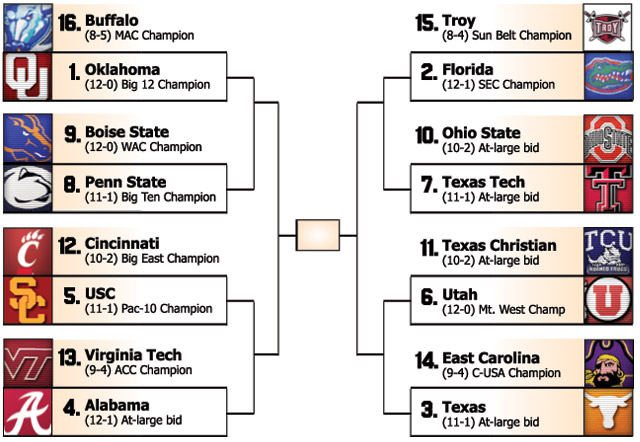
The benefits to the 8 team playoff is it doesn't extend the season by much and it is still a very elite group of teams involved. And it is still better than what we have now. But it does have some serious flaws. The main flaw is how do you select the teams? If you take the conference champs plus 2 based on BCS standings you would have this: 1. Oklahoma 2. Florida 3. USC 4. Penn State 5. Cincinnati 6. Virginia Tech 7. Texas 8. Alabama.

But the big thing missing here is a non-BCS school. It would be almost impossible for a non-BCS school to get into the playoff because they would have to finish in AT LEAST the top 8 in the final standings. And in this years case the top 4.So if you wanted to add a non-BCS school than you would eliminate Alabama and put in Utah. Does that solve anything? You just took out a top 4 team to accommodate a non-BCS school. But you have to or the non-BCS schools with sue and everything will change again.

Okay so instead of using the conference champions lets just choose our teams based on the BCS Standings. This years tournament would be this: 1. Oklahoma 2. Florida 3. Texas 4. Alabama 5. USC 6. Utah 7. Texas Tech 8. Penn State. But now you have left out 2 BCS conferences. And in most years you would still be leaving out a non-BCS school. If you win your BCS conference (no matter how weak) than you should be included in the playoff.

A 16 team playoff based on BCS rankings and conference champions (6 champs plus 10 at large) would be including 3 teams that have 3 losses! I don't think the regular season would be diminished much with an 8 or 12 (more on that later) team playoff but multiple 3 loss teams would be making the regular season MUCH less important.

Link>> Article 3 - A 12 team playoff

12 teams....conference champions and the next 6 highest ranked BCS teams,

REGARDLESS of conference. There will be NO LIMIT to how many schools from one conference in this playoff. If you are with in the parameters for the playoff [then] you are in. This years rankings: 1. Oklahoma (Big 12 Champ) 2. Florida (SEC Champ) 3. Texas (at-large) 4. Alabama (at-large) 5. USC (PAC 10 Champ) 6. Utah (at-large) 7. Texas Tech (at-large) 8. Penn State (Big 10 Champ) 9. Boise State (at-large) 10. Ohio State (at-large) 11. Cincinnati (Big East Champ) 12. Virginia Tech (ACC Champ)

Give the top 4 teams a bye week. The bottom 8 play and the winners there play the top 4. It expands past the 8 team theory to allow the non-BCS schools and other schools that deserve a chance but doesn't get to the 16 team theory that would include 3 loss teams.

The first 2 rounds [are played] at the higher seeds campus. This would help with travel costs and assure that fans could and would show up to the games with ease. After that you would put the final 4 into 2 of the current BCS bowls. The Championship would be at another BCS bowl site.

The 1st round would take place the week after the season ends (this weekend coming up) on Friday (one game at 8:00) and Saturday (other 3 games). The 2nd round would take place the following week with the same Friday/Saturday split. The reason for the 2 night setup is so all the games can be televised. The semi finals would take place on January 1st and the National Championship a week later. This gives teams a week off in the middle to rest and get ready for more games.

I would watch EVERY SINGLE GAME! And I bet most people would too. Could you imagine the ratings for the semi-final games on NEW YEAR'S DAY? Everything would be on the line. That is in my opinion, what would be the best possible thing for college football. There is NO WAY an 8 or 16 team playoff would add as much drama. And the regular season wouldn't lose much either. Sure a game or two (Fla/Bama this year, Mich/OSU a couple years ago) would lose SOME LUSTER but really wouldn't the fans be WINNING with the games we get after the season.


IT IS TIME FOR A PLAYOFF - List of Articles (with links)

Chapter 1 - Background
Chapter 1A - Background, Part 2
Chapter 2 - Example of Problem
Chapter 3 - Jim Ruppert’s Bowl Schedule
Chapter 4 - Another Point of View
Chapter 5 - Case Against 8 or 16 teams
Chapter 6 - Congress Gets Involved
Chapter 7 - Alternative 16 Team Plan
Chapter 8 - And More…
Chapter 9 - As I See It

IT IS TIME FOR A PLAYOFF - Chapter 4 - Another Point of View

Many, including President-Elect Barack Obama are proponents of an eight team playoff. The unidentified author of the following article makes the case for an 8 team playoff.

Highlands Today > News

It's Not Life And Death, But BCS National Champ System Stinks

The Tampa Tribune
Published: December 10, 2008

Few college football fans are questioning Florida's right to play for the title. They knocked off the No. 1 team in the country and won the SEC to earn that right. Oklahoma, on the other hand, is swirling in controversy. A lot of people believe the Texas Longhorns deserve to face Florida, since Texas beat Oklahoma head to head on a neutral field this season. And there are a couple of undefeated teams, but in lesser conferences.

No one denies, though, that Oklahoma is a great team. The question is why is the national title left up to silly Bowl Championship Series computations using polls and computers? Several teams have a legitimate argument for earning a right to play for the title. Unfortunately, university presidents and bowl directors just won't let that happen. It's all about greed.

Even President-elect Barack Obama has said there should be an eight-team playoff for the national championship. We agree. All that's required is for the top eight teams to begin play a week or two after the regular season ends. That would make it a three or four week tournament for the national title. All the major bowls could still be playoff sites, with the national championship rotating between them.

It's seems crazy that bowl directors believe this will lose them money. If anything, it will boost their revenue because the teams playing would still be in the hunt for a national championship.

With all the important issues in our country right now, deciding a national championship sounds trivial at best. But for a lot of people it's important. As it stands, it's a broken system, but it could easily be fixed. Let's hope changes come fast.


IT IS TIME FOR A PLAYOFF - List of Articles (with links)

Chapter 1 - Background
Chapter 1A - Background, Part 2
Chapter 2 - Example of Problem
Chapter 3 - Jim Ruppert’s Bowl Schedule
Chapter 4 - Another Point of View
Chapter 5 - Case Against 8 or 16 teams
Chapter 6 - Congress Gets Involved
Chapter 7 - Alternative 16 Team Plan
Chapter 8 - And More…
Chapter 9 - As I See It

Saturday, December 20, 2008

IT IS TIME FOR A PLAYOFF - Chapter 3 - Jim Ruppert's Bowl Schedule

Very similar to the first article. Consider how fantastic and compelling these matchups would be! The difference is that Jim Ruppert is saying use existing bowl games which would mean more travel for more teams than if the top seeded teams played on their home field for the first three rounds...


Jim Ruppert: Ruper Bowl would eliminate BCS mess

Jim Ruppert, SJ-R.com sports editor
THE STATE JOURNAL-REGISTER -
Springfield, Illinois
Posted Dec 08, 2008 @ 11:03 PM

The Bowl Championship Series has spoken. Florida and Oklahoma will play Jan. 8 in Miami for the heavyweight football championship of the world.

No less of an authority than President-elect Barack Obama has let the world know he thinks there should be a playoff to determine college football’s national champion. Enough of this Harris Interactive stuff. The USA Today coaches’ poll is good for generating conversation but not suited for determining the best football team in the land. And computers? What qualifies a computer to assess the heart of linebacker with a sprained ankle trying to play for his teammates?

A playoff is the only answer. For the past five years or so, this space has been devoted to keeping the NCAA and college football from messing with the current bowl system while also putting a playoff system in place.

... We use the top 16 teams in the final BCS standings that were released Sunday. We match them up in tournament fashion, 1 vs. 16, 2 vs. 15, etc.

The first round would be played Dec. 20, eight games in all. Then we’d have the four quarterfinal games on Dec. 27. The semifinals would be played Jan. 1 for old-time’s sake. And the national championship game would be ready to go Jan. 8 as advertised.
There would little or no missed class time because just about every school in America is on winter break on or around Dec. 15.

And the rest of the 33 bowl games that are out there, they can have their choice of any of the remaining schools in America. Take one that’s eliminated from the Ruper Bowl if you want. There’s plenty to go around.


So, in the first round, the lower eight of the sixteen teams have an opportunity to prove the pundits wrong. You could have four of the games on Saturday and the other four on Sunday. The NFL could actually take two week off, giving the players and staff a Christmas break. Assuming the top eight teams survive the first round, there would be some very compelling round 2 matchups: Oklahoma vs. Penn State, Florida vs. Texas Tech, , Texas vs. Utah and Alabama vs. USC. Again, split this between Saturday and Sunday.

Assuming that the top four seeds win again, now it's Oklahoma vs. Alabama, and Florida vs. Texas for the semifinals. Rather than New Year's Day, I'd put these games on the nest weekend. Whoever wins these two games play for a real National Championship on the next Saturday. Who wouldn't want to see this?

IT IS TIME FOR A PLAYOFF - List of Articles (with links)

Chapter 1 - Background
Chapter 1A - Background, Part 2
Chapter 2 - Example of Problem
Chapter 3 - Jim Ruppert’s Bowl Schedule
Chapter 4 - Another Point of View
Chapter 5 - Case Against 8 or 16 teams
Chapter 6 - Congress Gets Involved
Chapter 7 - Alternative 16 Team Plan
Chapter 8 - And More…
Chapter 9 - As I See It

IT IS TIME FOR A PLAYOFF - Chapter 2 - Example of Problem

Just in case you are saying "What's the big deal? The best teams are going to the big bowl games and we can trust the polls to pick the best two teams to play head to head for the National Championship." The previous article highlighted why we can't trust the polls or the bowl committees.

I found the following parody on the Zook Free Zone message board. Yes, it is totally fiction, but it sounds about right to me as to how the BCS would have declared the winner of World War II...

BCS DECLARES GERMANY WINNER OF WORLD WAR II - US Ranked 4th

After determining the Big-12 championship game participants the BCS computers were put to work on other major contests and today the BCS declared Germany to be the winner of World War II.

"Germany put together an incredible number of victories beginning with the annexation of Austria and the Sudetenland and continuing on into conference play with defeats of Poland, France, Norway, Sweden, Denmark, Belgium and the Netherlands. Their only losses came against the US and Russia; however considering their entire body of work--including an incredibly tough Strength of Schedule--our computers deemed them worthy of the #1 ranking."

Questioned about the #4 ranking of the United States the BCS commissioner stated "The US only had two major victories--Japan and Germany. The computer models, unlike humans, aren't influenced by head-to-head contests--they consider each contest to be only a single, equally-weighted event."

German Chancellor Adolph Hitler said "Yes, we lost to the US; but we defeated #2 ranked France in only 6 weeks." Herr Hitler has been criticized for seeking dramatic victories to earn 'style points' to enhance Germany's rankings. Hitler protested "Our contest with Poland was in doubt until the final day and the conditions in Norway were incredibly challenging and demanded the application of additional forces."

The French ranking has also come under scrutiny. The BCS commented " France had a single loss against Germany and following a preseason #1 ranking they only fell to #2."

Japan was ranked #3 with victories including Manchuria, Borneo and the Philippines.


IT IS TIME FOR A PLAYOFF - List of Articles (with links)

Chapter 1 - Background
Chapter 1A - Background, Part 2
Chapter 2 - Example of Problem
Chapter 3 - Jim Ruppert’s Bowl Schedule
Chapter 4 - Another Point of View
Chapter 5 - Case Against 8 or 16 teams
Chapter 6 - Congress Gets Involved
Chapter 7 - Alternative 16 Team Plan
Chapter 8 - And More…
Chapter 9 - As I See It

Tuesday, December 16, 2008

IT IS TIME FOR A PLAYOFF - Chapter 1 - Background

For a start on this topic, let's start with a recent article at Yahoo Sports by Dan Wetzel. Dan does a very good job of giving a historical perspective to the issue. I've included all of Dan's article here because it is simply the best I've even seen on the issue, and it is important to understand before continuing the discussion..

Link: Wetzel’s playoff plan: I’ll drink to that By Dan Wetzel, Yahoo! Sports Dec 2, 2:39 pm EST

The Bowl Championship Series has been in place since the 1998 season. This season’s championship game will be held on Jan. 8, 2009 in Miami.

Before we get to the playoff, let’s start by giving the Bowl Championship Series some credit. It might not be a good system, but it is better than the old one.

For decades, college football “determined” its champion by having two or three of its highest-rated teams play on New Year’s Day, only rarely against each other.

Fans at home would turn the channel (manually) and wonder why they couldn’t just have that great team play this great team rather than blow out two inferior opponents. (Too complicated was the answer.)

At the end of the day, a bunch of sportswriters, who probably watched only the game they covered in person, held a vote and named the “national champion.”

That was the system. Seriously, that was the system. If you set out to design the worst possible and least satisfying way for a sport to stage a championship, this might be it. Only through the clouds of nostalgia (and New Year’s hangovers past) does it seem even remotely palatable. Any college football is fun to watch, so you took what you got.

At least the BCS uses a convoluted formula to choose the two “best” teams and makes them play each other. For that we are grateful. The result has been a surge in interest in the sport. Which the apologists for the BCS like to claim proves their genius.

It doesn’t.

The old system was like non-alcoholic beer. The BCS is like near beer – that low-alcohol stuff that gets sold in some locales. Given no other choice people prefer near beer over the non-alcohol stuff. That’s not a compliment to near beer. It’s like saying the BCS has a nice personality.

A playoff is the real thing, real beer in all its varieties. If you think college football is popular now, imagine if it did away with the nonsense. You don’t even have to drink beer to know real beer outsells the other two about a million to one. (You do have to
acknowledge the similar addictive elements of alcohol and college football though.)

So forget these clowns patting each other on the back for creating a system better than the worst system ever.

We’re demanding real beer here and like grown-ups will lay out the best postseason system while discrediting the foolish obstructionist counter-arguments. Don’t credit me with the following genius – it’s essentially the exact same playoff system the NCAA uses for all other divisions of football.

(Please note, while I would prefer a men’s basketball style committee to set the field and follow some set guidelines that would prevent things such as in league matchups in the first round, for the sake of this argument I used the final BCS standings to place and seed the field).

A 16-team field (Editor's note: Dan wrote this based on the results prior to the last weekend of the season, therefore he is not using the final BCS rankings below. His analysis based on the results at the time, however, make sense -Gator Duck)


Just like in what used to be Division I-AA, the tournament would feature four rounds with teams seeded one through 16. Just like the wildly popular and profitable NCAA men’s basketball tournament, champions of all the conferences (all 11 of them) earn an automatic bid to the field.


Yes, all 11. Even the lousy conferences. While no one would argue that the Big South champ is one of the top 16 teams in the country, there are multiple benefits of including champions of low-level leagues.


First is to do what the apologists claim a playoff would ruin – maintain the integrity and relevancy of the regular season. While the idea that the season is a four-month playoff is both inaccurate and absurd, there should be a significant reward for an exceptional season.


The chance for an easier first-round opponent – in this case No. 1 seed Oklahoma would play No. 16 Buffalo – is just that. Earning a top two or three seed most years would present a school a near breeze into the second round, a de facto bye.


Drop to a four seed in this year’s scenario and you are dealing with a pretty tough Virginia Tech squad.


On the flip side, it brings true Cinderella into the college football mix for the first time. Is it likely that Tulsa could beat Oklahoma? Of course not, but as the men’s basketball tournament has proven, the mere possibility (or even a close game) draws in casual fans by the millions.


Perhaps the most memorable college football game of the last few years was Boise State-Oklahoma, in part because Boise was the unbeaten underdog that wasn’t supposed to win. When it did, in dramatic fashion, it became the talk of the country. There would’ve been historic interest in seeing if the Broncos could do it again the following week.


Why wouldn’t college football want that?


The BCS said Boise State had no shot at a national title in 2007 because either 1) it wasn’t any good in 1977 or 2) wasn’t geographically or politically situated to be in the proper conference. As illogical as this is, that’s the system.


For even lower-rated conferences – the Sun Belts, C-USA – allowing annual access to the tournament would not only set off celebrations on small campuses but it would encourage investment in the sport at all levels. Suddenly, there would be a reason for teams in those leagues to really care. This would improve quality throughout the country.


By extending the postseason to more conferences and teams, it would actually increase interest. It would not simply make the regular season matter more it would make more regular seasons matter.


With the old system, things such as the MAC championship game, which featured Buffalo upsetting Ball State was virtually meaningless. It wouldn’t have been if a berth to the playoff (and in BSU’s case what would’ve been a pretty good seed) was riding on it.


Who’s against more meaningful games?


With the bigger conferences, a championship would take on greater value. Does anyone without direct rooting interest really care who won the ACC title game?


And while everyone was fired up about the high stakes in the Florida-Alabama SEC championship, most conference title games pit one great team against a lesser one just playing spoiler (i.e. Missouri-Oklahoma). But what if Missouri had something to really play for? And Oklahoma was still desperate to maintain that high seed?


At-large bids


In addition to the 11 automatic bids, there would be five at-large selections made by a basketball-like selection committee which could agree on what criteria it values. This is where independents, such as Notre Dame, would have access to the tournament. Most years, all five bids would come from the power conferences (ACC, Big East, Big Ten, Big 12, Pac-10 and SEC).


This year, the at-large process would allow for a shift in power out west. Texas Christian of the Mountain West would join league champion Utah in the playoff. Considering the league went 6-1 against local rival the Pac-10, it’s well earned. No longer would perception and politics trump reality.


While the selection process would still draw complaints from the teams left out, those schools often would have two or three losses or significant flaws. Gone forever would be the days of an unbeaten Auburn in the 2004 season not getting a chance at the title or the bizarre 2003 season where nearly everyone thought USC was the best team but it got left out anyway.


The apologist argument that the complaints and controversies would never cease is silly. It’s pretty easy to tune out a three-loss Oklahoma State team. One-loss Texas? Not so much.


Ignore outdated bowls


Cincinnati coach Brian Kelly accepts the trophy for winning the Papa Johns.com Bowl against Southern Mississippi on Dec. 22,
2007.


BCS bowl games are the single worst deal in American sports. College football’s continued willingness to be fleeced by outside businessmen, who gleefully cut themselves in on millions in profits, is akin to the Knicks offering Stephon Marbury a contract extension right now.


What other business outsources its most profitable and easily sold product – in this case postseason football?


The bowls were needed back in the 1950s. These days they are nothing but leeches on the system. Outside of (again) nostalgia there is no value in these games. The NCAA could stage the games itself, cut out the middle men, and pocket tens of millions of extra revenue.


It has no place in a real solution. You’re allowing business outside college football to determine how college football does its business.


The bowl lobby is a powerful one though. ESPN itself owns six smaller games and isn’t going to rip the system. Most of the media blindly – or still drunk from bowl game media parties – follow the idea that a playoff must include the bowls.


Just about every idea you’ll hear or read will use these bowls for the quarterfinals and these for the semifinals and all of it is ridiculous.


The travel demands alone on teams and fans for three or four weeks of neutral sites make it implausible. Going neutral site makes seeds meaningless. This is exactly what the apologists want the debate to be about, a non starter of a solution.


The solution, however, is to ignore the bowls.


That isn’t to say eliminate them. The 34 bowl games can continue to operate outside of the playoff, just like any non-affiliated business. All the non-playoff teams can compete in them. With the BCS, only one game matters anyway. It’s not like the Sun Bowl is going to be all that different. If the people of El Paso want to continue staging the game, then they should.


First- and second-round losers in a playoff could even take a slot in a late December bowl game. As long as the bowls don’t mess with the playoff, who cares what they do? The more football the better.


At worst some of the true bottom-feeder bowls (the ones owned by ESPN) will have to fold for lack of eligible teams. The death of the PapaJohns.com Bowl is a price I think everyone is willing to pay. Maybe even Papa John himself.


Home games for higher seeds early


The playoff would stage the first three rounds at the home field of the higher-seeded team before shifting to a neutral site, a la the Super Bowl. As a nod to history, it could be a rotation of famed stadiums such as the Rose Bowl, et al.


This allows the playoff to capitalize on perhaps college football’s greatest asset – the pageantry, excitement and history of on-campus stadiums. There is nothing like a game day and it doesn’t matter whether you’re in Tuscaloosa or Ann Arbor or Norman or Los Angeles. Each one is uniquely thrilling and adds tremendous value to the product.


So why does college football stage its postseason in antiseptic pro stadiums?


Hosting games would be a boon to the schools and the campus communities – literally tens of millions of dollars into the local economy.


It would also reward the higher seeds (again placing value on the regular season) by providing the distinct advantage of playing at home. To be a top two seed, and host through the championship game, would be a monster reward.


This would also placate complaints from northern teams that are seemingly always playing bowl games near the campus of their opponent.


We’ve seen, say, USC have its way with Ohio State and Michigan in Pasadena, but what if the Trojans had to travel to Ohio Stadium on a cold and snowy day? Perhaps USC could prove it has grit not just talent. Intra-sectional games have all but died out due to recent scheduling philosophies, but the idea of them returning each December and January, famous jerseys in famous faraway stadiums can warm any fanâs heart.


The schedule


While the former Division I-AA plays all four rounds in four weeks and stages the title game before Christmas, football’s top division might be better served playing the first one or two rounds in December, breaking for final exams and staging the semifinals just after Christmas and the title game in early January.


Different schools have different academic schedules – two guys sent me a chart last year that showed there was no weekend when someone wasn’t having exams. However, college athletics has never allowed academics to stand in its way before. In this day of 12-team super leagues and midweek television games, this isn’t an excuse.


Something can be worked out.


One of the apologists’ greatest whines is that a playoff would make the season too long. It’s conceivable that some teams would play 17 games. Oh the horror! Mike Tranghese, commissioner of the Big East, once claimed, with a straight face, that so many players would be injured a team might not complete the playoff. Due to the way college football runs its clock, there are about 10 percent more plays in a college game than a pro one (135 to 122), which means they’re already playing an extra game, game and a half now.


Really? The kids at the old Division I-AA, Division II and III must just be tougher, even though they often sport smaller rosters than major college football. In plenty of states high school teams that win the state title play between 16 and 18 games and the best players often compete on both offense and defense. The NFL does it and more with just 53-man rosters.


The truth is it’s not the number of games that raises the risk of injury; it’s the number of plays. Each snap of the ball is the trigger that puts bodies in motion and risks potential injury. A game is just a grouping of plays, it holds no value.


Due to the way college football runs its clock, there are about 10 percent more plays in a college game than a pro one (135 to 122), which means they’re already playing an extra game, game and a half now. If they’re that concerned about the health of the players, they should continue to tinker with the clock to reduce the number of plays.


This is just a weak smoke screen. If the suits who count the money in college athletics actually cared about the welfare of the players, the number of reforms would be dramatic. Staging fewer games would be deep on the to-do list. Since the college schedule would still be shorter than the NFL (12 to 16) and fewer teams would qualify for the playoffs (13.3 percent to 37.5 percent) the idea that the college regular season would become less meaningless wouldn’t seem to wash. There are plenty of meaningless games now as teams attempt to pad their record and just survive the season unbeaten, sneak into the title game and go for broke there.


With a playoff, that wouldn’t be possible. You’d earn your title by surviving a four-game test that would rival the NFL playoffs.


The presidents


There’s nothing easier than blaming it on those guys. They don’t want a playoff, everyone says. The truth is they’ve never been presented a real playoff plan. Presidents are notoriously weak-spined and revenue desperate. Pressure and cash can change opinions in a hurry. They follow the herd.


“It’s not a question of if there is going to be a playoff, it’s going to be a question of when,” T.K. Wetherell, president of Florida State said last spring. “It’s going to be driven by money. None of us sitting at this table … are ever going to admit that.”


Unfortunately, last spring four leagues – the Big East, Big Ten, Big 12 and Pac-10 – fought to stop the SEC’s plan for a modest plus-one plan from even being discussed.


The reason? They feared that once fans got a taste of even a mini-playoff, they’d demand a real playoff.


Kind of like getting a taste of near beer; pretty soon you’re going to want the real thing.


IT IS TIME FOR A PLAYOFF - List of Articles (with links)

Chapter 1 - Background
Chapter 1A - Background, Part 2
Chapter 2 - Example of Problem
Chapter 3 - Jim Ruppert’s Bowl Schedule
Chapter 4 - Another Point of View
Chapter 5 - Case Against 8 or 16 teams
Chapter 6 - Congress Gets Involved
Chapter 7 - Alternative 16 Team Plan
Chapter 8 - And More…
Chapter 9 - As I See It

Sunday, December 7, 2008

TIM TEBOW PROVES MAN OF HIS WORD

Mike Bianchi | SPORTS COMMENTARY
1:38 AM EST, December 7, 2008
ATLANTA

The last time the Florida Gators lost a game, Tim Tebow, his eyes watering and his voice cracking, swore he would never let it happen again.

On Saturday, the University of Florida's intense, incandescent icon lived up to his promise one more time and in the process led the streaking Gators to an epic 31-20 victory over No.1 Alabama in the Southeastern Conference Championship Game and a likely spot in the national-championship game against Oklahoma.

Just when you think Tebow's legend can't become any more immense, he comes out and does something he's never done before. He guided the Gators to a dramatic fourth-quarter comeback and put himself in prime position to become only the second player in college-football history to win two Heisman Trophies.

Follow link to read more